Short Term Loans in Australia
Key takeaways
- A short term loan in Australia is a small amount of credit, typically $300 to $2,000, repaid over roughly 16 days to 12 months; most are regulated Small Amount Credit Contracts (SACCs) whose fees are capped by law.
- For a SACC, the law caps fees at an establishment fee of up to 20% of the amount borrowed plus a monthly fee of up to 4%; these are illustrative legal maximums, not a quote, and the licensed lender who assesses the application sets the actual cost.
- Medium Amount Credit Contracts (roughly $2,001 to $5,000) are capped at 48% per annum interest plus a single establishment fee of up to $400.
- Perfect Payday is a credit referral service, not a lender; applications are passed to a panel of licensed lenders who assess affordability under responsible-lending law and make any decision, and applying never guarantees approval.
- Interest-free alternatives are often cheaper than a short term loan, including a Centrelink Advance Payment and a No Interest Loan (NILS) of up to $2,000; the free National Debt Helpline on 1800 007 007 offers confidential financial counselling.
Quick honesty note. Perfect Payday is not a lender. It’s a trading name of Tiny Ventures (ABN 52 168 226 480), Credit Representative No. 516845, a credit referral service. When you apply, we may pass your details to a panel of licensed lenders who assess your application and set any rate, since we don’t decide that, and we may receive a fee if you proceed. This page explains how short term loans work in plain terms, including the cheaper options that might suit you better than borrowing at all.
Short term loans are small amounts of credit you borrow and repay quickly, usually somewhere between 16 days and 12 months. In Australia most of them are a specific, regulated product called a Small Amount Credit Contract (SACC), which means the fees a lender can charge are capped by law. On this page we explain what short term loans are, what they cost, who they suit, and (just as importantly) when something cheaper is the smarter move.
What is a short term loan?
A short term loan is exactly what it sounds like: a relatively small sum borrowed for a short period. People use them to cover an unexpected bill, a car repair, a vet visit or a gap between pay cycles. Because the repayment window is short, they’re designed for temporary cash-flow problems, not for long-term or ongoing financial gaps.
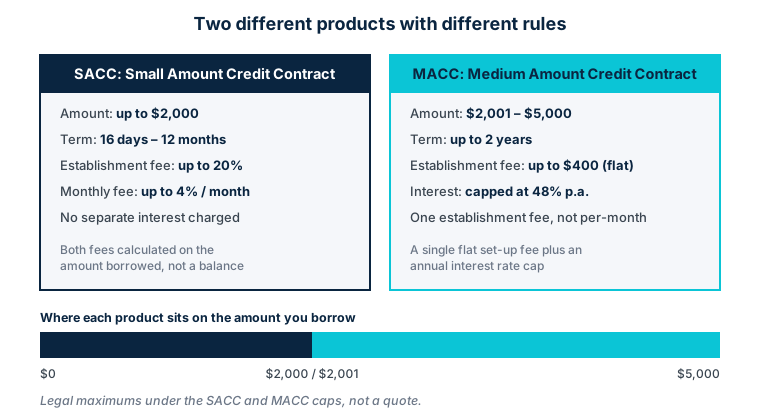
In regulatory terms, most short term loans in Australia fall into one of two categories:
| Type | Amount | Typical term | Key rule |
|---|---|---|---|
| Small Amount Credit Contract (SACC) | Up to $2,000 | 16 days – 12 months | Fees capped: 20% establishment + 4%/month |
| Medium Amount Credit Contract (MACC) | $2,001 – $5,000 | 16 days – 2 years | Interest capped at 48% p.a. + one $400 establishment fee |
The product most people mean by “payday loan” or “fast cash” is a SACC. If you want the detail on how that product is structured end to end, our guide on how payday loans work walks through the full process.
How do short term loans work?
The basic mechanics are straightforward:
- You apply for a set amount over a set term. With Perfect Payday, that application goes to a panel of licensed lenders.
- A licensed lender assesses you. They’re legally required to check that repayments fit your budget under responsible-lending law. This usually means reviewing recent bank statements, income and expenses.
- If approved, you sign a contract setting out the amount, the fees, the repayment schedule and the total you’ll repay.
- You repay in instalments (often aligned to your pay cycle) until the loan is cleared.
Repayments are typically taken by direct debit on or just after payday, which is where the old “payday loan” name comes from. Because the term is short, instalments can feel large relative to the amount borrowed, so it’s worth mapping repayments against your budget before you commit.
Tip: ASIC’s free Moneysmart payday loan calculator lets you see what a short term loan could cost and compares it against alternatives, a useful sanity check before you apply anywhere.
What do short term loans cost?
For a SACC, the law sets clear maximums. A lender cannot charge more than:
- an establishment fee of up to 20% of the amount borrowed, plus
- a monthly fee of up to 4% of the amount borrowed.
There’s no annual percentage rate in the usual sense; instead these flat caps apply. There may also be government fees and, if you miss a payment, default fees (which are themselves limited by law).
Why the caps are worth knowing before you apply
Knowing the ceiling is what lets you recognise a fair offer when one lands in front of you. A licensed lender may charge less than 20% up front and less than 4% a month, but never more on a SACC, and there is no separate interest sitting behind those fees. Since both are struck against the amount borrowed rather than a falling balance, a longer term costs more even when the loan itself is the same size. Our guide on how each fee is worked out takes the caps apart line by line.
It’s worth understanding why short term loans look expensive when you express the cost as an annual rate. Because the fees are flat and the term is short, a small fee can equate to a high effective annual percentage rate even though the dollar amount is modest. That maths is fine when the loan really is short term and repaid on schedule. It becomes a problem when a loan is rolled over, refinanced or repaid late, which is exactly when the cost can balloon. Short term loans reward being repaid quickly and punish being stretched out, so the safest approach is to borrow the smallest amount over the shortest term you can manage.
For Medium Amount Credit Contracts (roughly $2,001 to $5,000), the structure is different again: interest is capped at 48% per annum and a lender can charge a single establishment fee of up to $400. These are a step up in size and commitment, so the affordability assessment matters even more.
Does paying weekly instead of monthly save money?
On an interest-bearing personal loan, yes: paying weekly chips the balance down sooner, so slightly less interest accrues, and comparison articles often show a small saving from switching frequency. On a SACC it doesn’t work that way. The 4% monthly fee is charged on the original amount borrowed no matter how fast the balance falls, so a $1,500 loan over 6 months costs the same total whether you pay weekly, fortnightly or monthly (at the legal maximum, $300 establishment plus $360 in monthly fees, $2,160 all up). Pick the frequency that matches your pay cycle for budgeting; on this product it changes convenience, not cost. What does cut the total on a SACC is a shorter term, because each month adds another 4%.
The protected-earnings rule (this one protects you): by law a lender generally can’t sign you up to a SACC if your total SACC repayments would exceed 10% of your net income. If a lender ignores that, it’s a red flag, and grounds for a complaint to the Australian Financial Complaints Authority (AFCA).
Types of short term loan, and where to read more
“Short term loan” is an umbrella term. Depending on how you search and what you need, you’ll see the same basic product under several names. Here’s how they relate:
- Payday loans: the classic small-amount SACC repaid over your pay cycles. This is the core product most short term borrowers use.
- Cash loans: broadly the same thing, framed around getting cash quickly for everyday expenses.
- Same day loans: short term loans where the focus is on speed of funding. Same-day funding is possible if you’re approved and verified early enough, but it’s never guaranteed.
They share the same legal framework and the same fee caps. The differences are mostly about emphasis (amount, speed, or how the loan is marketed) rather than a fundamentally different product.
Who do short term loans suit?
A short term loan can make sense when all of the following are true:
- the expense is genuinely short-term and you can see how you’ll repay it within the term;
- you’ve checked the cheaper alternatives below and they don’t fit your timeline or situation;
- the repayments fit your budget comfortably, not just barely.
They’re a poor fit if you’re borrowing to cover ongoing living costs, to pay off another loan, or if money is already tight every fortnight. In those cases more debt usually makes the problem worse, not better, and free help is available.
Bad credit or on Centrelink?
A short term loan isn’t automatically out of reach if you have a low credit score or receive government payments. Licensed lenders weigh your current ability to repay rather than your score alone, and many accept Centrelink income. You’ll still need to pass an affordability check, and applying never guarantees approval. If you’re on benefits, read our dedicated guidance on Centrelink loans first. There are often cheaper routes.
Cheaper alternatives worth checking first
Because this is your money, it’s only fair to point out the options that frequently beat a short term loan on cost:
- Centrelink Advance Payment: if you receive an eligible Centrelink payment, you can bring forward part of it interest-free and repay only what you took. See the Services Australia advance payments page.
- No Interest Loan (NILS): for essentials like a fridge, car repairs or medical costs, you can borrow up to $2,000 with no interest and no fees. Call 13 NILS (13 6457) or use the Good Shepherd NILS locator.
- National Debt Helpline: 1800 007 007. Free, confidential financial counsellors (not salespeople) who can help you find options you may not have considered. More at the National Debt Helpline.
- Talk to who you owe. Many utilities and councils offer hardship plans or payment extensions at no cost. Sometimes that’s all you need.
How to choose a short term loan wisely
If you’ve decided a short term loan is the right tool, a little structure helps you avoid the common traps:
- Borrow only what the expense requires. Rounding up “just in case” increases both the fees and the repayments. The smallest workable amount is almost always the cheapest decision.
- Match the term to the need. A longer term lowers each instalment but adds monthly fees; a shorter term costs less overall but demands a tighter budget. Pick the shortest term whose repayments you can comfortably meet.
- Read the contract before you sign. It must state the amount, every fee, the repayment schedule and the total you’ll repay. If anything is unclear, ask; a reputable lender will explain it.
- Check the lender is licensed. They should hold an Australian Credit Licence (or act for one) and be an AFCA member. If you can’t verify this, walk away.
- Watch for pressure. Genuine lenders give you time and don’t promise outcomes before they’ve assessed you.
A short term loan that’s chosen carefully and repaid on time does what it’s meant to do: cover a one-off gap and then disappear. Trouble usually starts when the loan is bigger than it needed to be, or when it’s used to plug a recurring shortfall.
Repaying on time, and what to do if you can’t
Repayments are typically set up as direct debits around your payday. Before you commit, write down what’s leaving your account each fortnight and make sure the loan repayment still leaves enough for rent, food, bills and a small buffer. If the numbers only just work, that’s a signal the loan may be too large or too short, or that a cheaper option is the better call.
If your circumstances change and you think you’ll miss a payment, contact the lender early. Under Australian law you can ask for a hardship variation (a temporary pause or reduced repayments), and the lender must consider it. Acting before a payment bounces saves you default fees and protects your credit file. If you and the lender can’t agree, you can take a free complaint to AFCA, and a free financial counsellor on the National Debt Helpline (1800 007 007) can help you negotiate.
Your rights when you borrow
Every licensed lender in Australia must:
- hold an Australian Credit Licence (or operate as an authorised representative of one);
- assess affordability before lending under responsible-lending obligations;
- be a member of AFCA, so you can complain free if something goes wrong;
- give you a contract that clearly states the fees, repayments and total cost before you sign.
If a provider promises guaranteed approval, claims no credit check, or pressures you to decide quickly, treat it as a warning sign. Responsible lenders don’t work that way, and the law requires them to check that you can afford to repay.
Applying through Perfect Payday
If you’ve weighed the cheaper options and a short term loan is still the right fit, you can apply below. We’ll pass your details to a panel of licensed lenders who assess affordability and make any decision. We don’t set the rate or approve the loan. Applying is free and never guarantees approval. Borrow only what you need, and only what you can comfortably repay.
Work out the legal maximum cost
See the most a payday loan (a Small Amount Credit Contract) can legally cost in Australia, capped at a 20% establishment fee plus a 4% monthly fee. This is an illustrative maximum: your actual rate depends on the licensed lender who assesses you.
Most it can legally cost
- Establishment fee (max 20%)$200
- Monthly fees (max 4% × 6)$240
- Maximum cost of credit$440
- Most you would repay$1,440
- ≈ per fortnight$111
Illustrative only, capped by law. A Centrelink advance or a No Interest Loan (NILS) may cost $0 in fees.
Frequently asked questions
What is a short term loan in Australia?
A short term loan is a small amount of credit (typically $300 to $2,000) repaid quickly, usually over 16 days to 12 months. Most are legally Small Amount Credit Contracts (SACCs) and the fees are capped by law.
How much can I borrow with a short term loan?
Small Amount Credit Contracts are capped at $2,000. Larger short-term amounts (roughly $2,001 to $5,000) fall under Medium Amount Credit Contracts, which have different rules and an interest cap.
What do short term loans cost?
By law a SACC lender can charge an establishment fee of up to 20% of the amount borrowed plus a monthly fee of up to 4%. These are legal maximums; your actual cost depends on the licensed lender who assesses you.
Can I get a short term loan with bad credit or on Centrelink?
Possibly. Licensed lenders look at your current ability to repay, not just your credit score, and many accept Centrelink income. But you must still pass a responsible-lending affordability check, and applying never guarantees approval.
Is 'guaranteed approval' or 'no credit check' real?
No. Licensed lenders are legally required to assess affordability under responsible-lending law. Claims of guaranteed approval or no credit check are a warning sign, not a benefit.
How fast can I get the money?
If you're approved and verified, funds can often arrive the same day or within one to two business days, depending on the lender and your bank. Speed is never guaranteed.
Is Perfect Payday a lender?
No. Perfect Payday is a credit referral service. When you apply, we may pass your details to a panel of licensed lenders who assess your application and set any rate. We're not a lender and we don't make the decision.
What's a cheaper alternative to a short term loan?
A Centrelink Advance Payment or a No Interest Loan (NILS) is interest-free and far cheaper. A free financial counsellor on the National Debt Helpline (1800 007 007) can also help you find options you may not have considered.